When you buy through links on our articles, Future and its syndication partners may earn a commission.

The Artemis 2 astronauts have left Earth, but they aren't on their way to the moon quite yet.
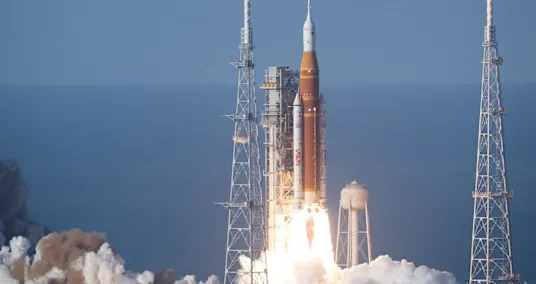
NASA's Artemis 2 mission launched on Wednesday (April 1) at 6:35 p.m. EDT (2235 GMT) from Florida's Space Coast, sending four people to Earth orbit aboard an Orion capsule.
The quartet will continue circling our planet until this evening (April 2), when Orion performs a crucial maneuver that sends it toward Earth's nearest neighbor.
That maneuver, known as a translunar injection (TLI) burn, is the main activity of Artemis 2's second day in space. It's scheduled to take place 25 hours and 37 minutes after launch — so, tonight at 8:12 p.m. EDT (0012 GMT on April 3).
"That puts us outbound to the moon. That's a real big commitment point," Norm Knight, director of NASA's Flight Operations Directorate, said during a postlaunch press conference on Wednesday.
Most of the operations that have occurred on the mission so far have helped build toward the TLI burn. For example, Orion performed several other maneuvers shortly after launch that helped get it in the proper orbit for that to-the-moon maneuver.
In addition, Mission Control and the Artemis 2 astronauts — NASA's Reid Wiseman, Victor Glover and Christina Koch and the Canadian Space Agency's Jeremy Hansen — have been putting Orion and its various systems through their paces, making sure the capsule is ready for a deep-space voyage.
"We're looking to make sure that the life-support systems work, that the vehicle's healthy," and that there's redundancy in communications and other key gear, Knight said. "We assure that those are functional, because once we commit to TLI, they have to function."
This work will continue through much of today. Then, this afternoon, the mission management team will meet to discuss the results "in preparation to make the decision on whether or not we proceed with the TLI burn," said Lori Glaze, acting associate administrator for NASA's Exploration Systems Development Mission Directorate.
If Orion is deemed unready for the TLI burn, Artemis 2 will get no farther than Earth orbit. If the mission team gives the green light, however, the spacecraft and its astronauts will make a figure-eight loop around the moon — a path chosen for its relative simplicity and safety.

"The translunar injection burn is the last major engine firing of the mission," NASA officials wrote in the Artemis 2 press kit.
"It propels Orion on a path toward the moon and sets it on the free-return trajectory that will ultimately bring crew back to Earth for splashdown," they added. "Though only two days into the mission, it essentially doubles as Orion's deorbit burn as well."
A successful TLI burn will make the Artemis 2 astronauts the first people to travel beyond low Earth orbit since the Apollo 17 crewmembers in 1972. Wiseman, Glover, Koch and Hansen will fly by the moon on Day 6 of the mission, then return to Earth on Day 10.
Their experience will help pave the way for even greater lunar leaps. NASA hopes to land astronauts on the lunar surface in 2028 on the Artemis 4 mission (after practicing docking with landers in Earth orbit on Artemis 3 in 2027), then start building a base near the lunar south pole a few years later.
LATEST POSTS
- 1
 The risk of falling space junk hitting airplanes is on the rise, experts warn
 - 2Instructions to Really Oversee Unsold SUVs in the Auto Business
- 3Watch SpaceX launch powerful ocean-mapping satellite for Europe and NASA early Nov. 17
- 4Air superiority and long-range strikes: what China's war games say about how it might assault Taiwan
- 5It Shouldn’t Be Here: Rescuers Race to Save Whale Stranded in Rare Spot



- Pick Your Number one breakfast food
- Fabricated statement about Malaysian national exam top scorers stokes racial sentiment
- Dave Coulier shares new cancer diagnosis 1 year after revealing previous diagnosis
- Step by step instructions to Recognize the Distinction Between Lab Jewels and Precious stone Simulants
- Israel halts defense sales to France, citing 'hostile attitude,' sources tell 'Post'
- He suddenly couldn't speak in space. NASA astronaut says his medical scare remains a mystery
- National health ranking puts Georgia near bottom of list. Here's why
- Doctor's orders: Eat ice cream, and other tips for a long and healthy life
- Esteem Stuffed Gaming Workstations to Consider