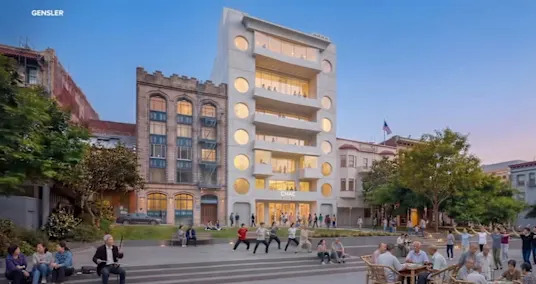
One of the most iconic towers in San Francisco's Chinatown is set to become a new cultural destination.
Community and city leaders unveiled plans Thursday to transform the historic Empress of China building into a cultural campus celebrating Chinese-American art, culture and history.
Once home to the famed Empress of China Banquet Hall, the building has been mostly vacant since it shuttered in 2015.
The nonprofit Chinatown Media and Arts Collaborative, a coalition of local nonprofits, finalized purchase of the property on Wednesday after a 15-year fight between the group and real estate investor John Yee, the building owner who was reluctant to sell.
San Francisco Supervisor Connie Chan said the prolonged vacancy took an emotional toll on the community.
MORE: SF Chinese Culture Center, oldest of its kind in the nation, celebrates new permanent home
"The view that you will see here is what your dreams can be beyond being and growing up in Chinatown," she said. "That was the dream that I had... and to see that how it left empty for so long, I think it broke a lot of our hearts."
CMAC plans to revitalize the 60-year-old structure into what leaders describe as a bustling ecosystem for Chinese-American celebration. The project includes a museum showcasing Chinese-American art, history and culture, along with other spaces aimed at drawing both locals and visitors.
"It's going to be a beacon for visitors and tourists to come to Chinatown to understand our story, a platform for us to tell our story," said Malcolm Yeung, CEO of the Chinatown Community Development Center. "We want to invite all of the supporters out there and helping us to determine how we use this building to tell our story in a way that is consistent with who we are as Chinatown."
Mayor Daniel Lurie connected the project to the city's broader recovery, both culturally and economically.
"I often say that as Chinatown goes, so goes San Francisco," Lurie said. "Our city does not succeed unless all neighborhoods see the benefits of a lasting recovery."
MORE: San Francisco's Chinatown pushes for preservation amid decline in business
Leaders say the project could also support the recovery of downtown San Francisco by drawing more visitors through Chinatown.
"Chinatown, because we are a living community where people actually come, we could direct people to downtown," said Mabel Teng, a board member of CMAC. "So I see us as serving as one of many engines that contribute to the city's recovery."
Teng, a former San Francisco supervisor, said the part of the sale agreement with Yee was to not disclose the cost of the sale. She said fundraising will be needed to sustain the project moving forward. Yee bought the building for $17.25 million in 2016.
"We all know fundraising is not easy. It is asking all our stakeholders and community to invest in their family's future," Teng said. "We have a future that we all share. We all share aspiration of what America promised to us."
She added that CMAC plans to keep the top and bottom floor restaurants, Empress by Boon and City View, in the tower.

If you're on the ABC7 News app, click here to watch live
LATEST POSTS
- 1
 The Job of a Migration Legal advisor: How They Can Help You
 - 25 Different ways Macintosh is Prepared to Overwhelm Gaming, Even Against Windows
- 3'People We Meet on Vacation' is the 1st of many Emily Henry adaptations: What other books turned movies to look forward to
- 4Israel strikes Beirut amid rocket fire from Hezbollah and Iran
- 5Getting through a Lifelong Change: Individual Examples of overcoming adversity



- FDA adds strongest warning to Sarepta gene therapy linked to 2 patient deaths
- The Quadrantid meteor shower peaks tonight, but will the full 'Wolf Moon' outshine the show?
- Step by step instructions to Pick the Right Web-based Degree Program
- Moon rush: These private spacecraft will attempt lunar landings in 2026
- German Easter peace marches draw tens of thousands
- FDA updates risk classification for voluntary shredded cheese recall
- Don’t let food poisoning crash your Thanksgiving dinner
- Bird flu poses risk of pandemic worse than COVID, France's Institut Pasteur says
- 6 Fledgling Cameras for 2024: Ideal for New Photographic artists