When you buy through links on our articles, Future and its syndication partners may earn a commission.

In-orbit manufacturing start-up Space Forge has produced its first plasma in orbit aboard the ForgeStar-1 satellite. It's a world first and a major step toward the company's vision of making novel semiconductors in space, which could revolutionize future electronic technologies.
UK-based Space Forge launched its pioneering ForgeStar-1 craft in June 2025 and has been bringing it to life since. In December 2025, the microwave oven-sized satellite fired up its miniature furnace for the first time and generated plasma — a stream of gas as hot as 1,832 degrees Fahrenheit (1,000 degrees Celsius). In future missions, such plasma will help SpaceForge forge super efficient, out-of-this-world materials in weightlessness.
"Generating plasma on orbit represents a fundamental shift, it proves that the essential environment for advanced crystal growth can be achieved on a dedicated, commercial satellite — opening the door to a completely new manufacturing frontier," Joshua Western, CEO and co-founder of Space Forge said in a statement.
SpaceForge, founded in 2018, plans to use a similar furnace on a future satellite to manufacture a batch of novel semiconductors directly in the weightless environment of space. Such experiments have previously only been conducted aboard the International Space Station.
"The plasma demonstration confirms that the extreme conditions needed for gas-phase crystal growth — a core building block of semiconductor production — can now be created and controlled on an autonomous platform in low Earth orbit," the company said in the statement. "The achievement establishes ForgeStar-1 as the first free-flying commercial semiconductor manufacturing tool ever operated in space."
Thanks to the absence of gravity, atoms in semiconductors grown in space align so accurately that the resulting material provides a superior performance to anything made on Earth. Space Forge estimates that the improved efficiency of these semiconductors could enable reductions in the energy use of electronic devices by up to 60 percent.
The semiconductors, based on rare materials such as gallium nitride, silicon carbide or diamond, could be used in future telecommunications systems, electronic devices and next-generation computers.
The current ForgeStar-1 will only test the orbital factory equipment. The satellite will deorbit and burn up in the atmosphere later this year. Before its mission ends, the craft will run more experiments to analyze how the generated plasma behaves in microgravity and collect data to help the company's engineers fine-tune the future missions.
Space Forge raised a generous Series A funding round of £22.6 million ($30.5 million) last year that will allow the company to build the successor satellite ForgeStar-2, which will make the first batch of Space Forge's made-in-space semiconductors. The spacecraft will be fitted with a novel heat shield to survive the atmospheric return and deliver its precious cargo safely to Earth.
LATEST POSTS
- 1
 Simple Consideration Plants for Home and Office: An Aide
 - 2Promising Speculation Bearings for Portfolio Development in 2024
- 3Mars spacecraft images pinpoint comet 3I/ATLAS's path with 10x higher accuracy. This could help us protect Earth someday
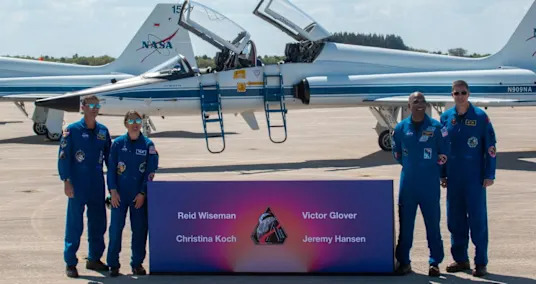
- 4Artemis 2 astronauts arrive at Kennedy Space Center ahead of NASA's historic launch around the moon
- 5Little Urban areas to Visit in Western Europe



- RFK Jr. releases new dietary guidelines with emphasis on protein, full-fat dairy
- Vote In favor of Your Favored Kind Of Organic product
- Agios Pharma shares jump as US FDA expands approval for its blood disorder drug
- Tech for Learning: Online Courses and Instructive Apparatuses
- France, Germany, Italy summon Iranian envoys over 'unbearable, inhumane' regime crackdown
- Scientists dove hundreds of feet into the ocean and found creatures no human has ever seen. Our trash beat us there
- The Best Traditional Music Arrangers in History
- The Best Music Collections of the 10 years
- The Force of Mentorship: Self-improvement through Direction