When you buy through links on our articles, Future and its syndication partners may earn a commission.

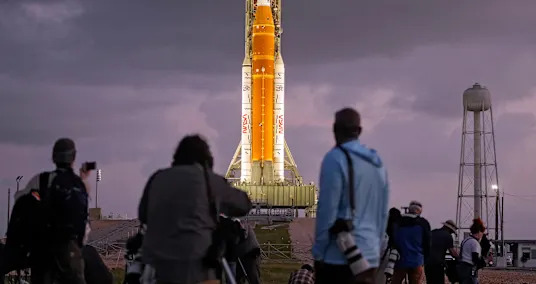
As the historic Artemis 2 mission toward the moon roared off the Florida coast earlier this week, it wasn't just people on the ground watching.
Astronauts aboard the International Space Station (ISS) also stayed up to witness the April 1 launch from orbit, cheering on their colleagues as the rocket carved its path skyward and began a journey that will take humans farther into space than ever before.
And soon, as the four-person Artemis 2 crew journey toward the moon, they will, for the first time, be able to look back from such a distance and see other humans circling Earth on the space station — a sight that did not exist when Apollo astronauts made their trips to the moon.
It's a striking measure of how much humanity's presence in space has evolved since the Apollo era, which ended with the Apollo 17 crewed moon landing in 1972. There have been more than 25 years of continuous human occupation aboard the ISS alongside the silent sweep of thousands of satellites.
That expanded space presence was on display during Artemis 2's launch, as both astronauts and satellites observed the moment from orbit, offering a rare, layered portrait of humanity watching the journey beyond. The event was seen from the ground, from space, and even from the sky as some lucky airplane passengers got glimpses overhead.
At the time of liftoff, the ISS — currently home to the seven-member Expedition 74 crew — was passing over the northern Pacific Ocean, too far away for the astronauts to see the launch directly. They instead followed it on NASA TV, staying past their bedtime to watch the launch, astronaut Chris Williams shared in a post on X.
About 30 minutes later, as the ISS swept closer to Florida, Williams said he caught sight of the lingering trail left by the rocket as it tore through the atmosphere — seen in the image below as a white plume twisted by winds at different altitudes.
Among the mission's many firsts, the ISS crew will speak with the Artemis astronauts in an audio-only conversation scheduled for Tuesday (April 7), according to NASA.
Those silent satellites also captured sweeping views of the historic launch. The GOES-19 weather satellite recorded the rocket's exhaust plume as a brushstroke-like arc seen in the video below.
Finally, this short video from the GOES-18 satellite shows the rocket launching into space, appearing to arc as it follows its planned trajectory along Earth's curvature.

The only Lego Technic NASA Artemis Space Launch System Rocket, once built it can 'launch' thanks to the clever Technic engineering mechanisms inside. It stands 27.5-inches (70 cm) tall but is made from only 632 pieces, making this suitable for ages 9+, compared with the adult-oriented (and $260) static Lego Icons NASA Artemis Space Launch System (10341) model.
LATEST POSTS
- 1
 Old food pyramid vs. RFK Jr.'s new food pyramid. See what's different.
 - 2Alleged Huione Group Money Laundering Boss Extradited to China
- 3Step by step instructions to Figure out the Natural Effect of 5G Pinnacles
- 4Tatiana Schlossberg's diagnosis puts spotlight on leukemia: What to know
- 5Have gravitational waves provided the first hint of primordial black holes born during the Big Bang?




- 41 Young Men Die in South Africa After Circumcision Initiation
- Benedict Cumberbatch takes on something even Sherlock can’t solve: male grief
- US bishops officially ban gender-affirming care at Catholic hospitals
- Renewables cover over 50% of German electricity consumption in Q1
- 6 Shades Brands For Seniors
- Change Your Physical make-up: Compelling Activities for Muscle Building
- The Latest: Fueling begins as NASA aims to send 1st crew to the moon in 53 years
- Artemis II astronauts are more than halfway to the moon as they seek to break Apollo 13's record
- Must-Sit in front of the Programs from Europe and the US