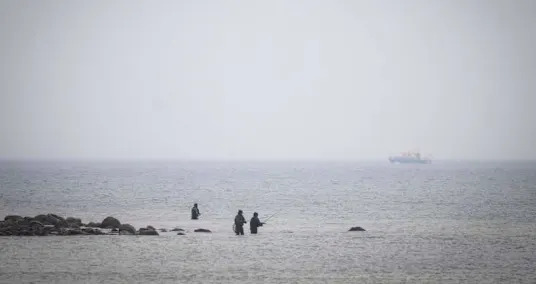
A humpback whale stranded for days off Germany's Baltic coast has gotten stuck on another sandbank, a Greenpeace spokeswoman said on Saturday.
The unlucky animal had garnered media attention for days, after it got stranded on a sandbank off Germany's Timmendorfer Strand resort, near the city of Lübeck, early on Monday.
Days of efforts to free the 12- to 15-metre whale proved unsuccessful until rescuers dug out a channel in the sand around the animal using a floating excavator on Thursday, allowing the whale to swim free the following night.
However, environmentalists and marine experts had feared that the animal could potentially get stuck again, as it was spotted heading back towards shallower water following its release.
Those fears became reality on Saturday, with the whale spotted stranded on a sandbank in the Bay of Wismar, some 40 kilometres to the east of Timmendorfer Strand, according to Greenpeace.
Large whales such as humpback whales are not native to the Baltic Sea. They may follow schools of fish in search of food and end up in the Baltic Sea.
According to experts, underwater noise could also play a role.

LATEST POSTS
- 1
 Man who grabbed Ariana Grande at 'Wicked: For Good' premiere also rushed Katy Perry onstage this year. Who is he and why is he doing this?
 - 2The Best Games Crossroads in History
- 3Flourishing in a Cutthroat Work Market: Vocation Methodologies
- 4The most effective method to Involve Handshakes for Compromise and Compromise
- 5Spain's Easter processions draw more tourists amid Iran war


- Explosions at Burundi ammunition depot kill civilians, witnesses say
- The most effective method to Amplify Profits from Gold Speculation: Systems and Tips
- As tetanus vaccination rates decline, doctors worry about rising case numbers
- The Fate of Mechanical technology: 5 Headways Forming Tomorrow
- Sources: IDF does not actually know how many ballistic missiles Iran has left
- Vote In favor of Your Number one Savvy Beds
- A rare whale is having an encouraging season for births. Scientists warn it might still go extinct
- Investigating the Financial History of the World: A Succinct Outline
- Putting pig organs in people is OK in the US, but growing human organs in pigs is not – why is that?